Introduction
What is a Personal Branding Statement?
In a professional landscape where, according to Statista, the average time a recruiter spends looking at a resume is just over 7 seconds, a compelling branding statement is your best tool for making an immediate and lasting impression. It’s the core message that informs every piece of your professional communication, from your LinkedIn headline and resume summary to your interview answers and networking introductions.
Why a Powerful Statement is Your Career Compass
Taking the time to craft your statement isn’t a one-off task; it’s an investment that pays dividends throughout your entire career. It provides the clarity and confidence needed to navigate the professional world effectively.
It Provides Unshakeable Clarity and Focus
The process of creating a branding statement is an exercise in profound self-reflection. It forces you to distill your skills, passions, and experiences into a focused message. This clarity becomes a powerful filter for decision-making. Imagine a marketing professional, Jane, whose brand was once generic. After crafting her statement—”I help B2B SaaS companies drive growth through data-backed content marketing”—she could confidently turn down roles in B2C or generalist marketing, knowing they didn’t align with her brand. This focus led her to her dream job at a top SaaS firm.
It Makes Networking Effortless and Effective
Armed with a clear and compelling statement, you can introduce yourself with confidence in any situation. It transforms awkward small talk into a strategic conversation. Consider the difference at a conference:
Before: “Hi, I’m Mark. I’m a software developer.” (This often leads to a dead-end conversation).
After: “Hi, I’m Mark. I build secure and scalable e-commerce platforms for retailers, helping them increase online sales and improve customer loyalty.” (This invites questions like, “Oh, interesting. What kind of retailers do you work with?”). It ensures that every new connection understands your value and how you can help them, making you instantly more memorable.
It Creates a Consistent and Memorable Brand
Your statement is the anchor for your entire professional brand. It ensures that your message is consistent across your resume, LinkedIn profile, personal website, and every other professional touchpoint. This consistency builds “brand equity,” just as it does for major corporations. When people in your network see the same clear, value-driven message everywhere, it reinforces your expertise and builds recognition. This makes you more memorable to recruiters and top-of-mind when opportunities arise. For more on building a consistent brand, explore our guide on social media branding.
The 4-Part Formula for a Winning Statement
Crafting your statement doesn’t have to be daunting. You don’t need to be a marketing genius. Follow this simple, proven formula to build it piece by piece, starting with a foundation of self-awareness.
Foundation: A Quick Self-Audit
Before you can write a single word, you must understand the product: you. Grab a notebook and answer these questions:
- Values: What are your top 3-5 core professional values (e.g., innovation, integrity, efficiency)?
- Passions: What problems do you genuinely love solving? What topics could you talk about for hours?
- Strengths: What are your greatest skills? What do others consistently compliment you on?
- Accomplishments: What results are you most proud of in your career?
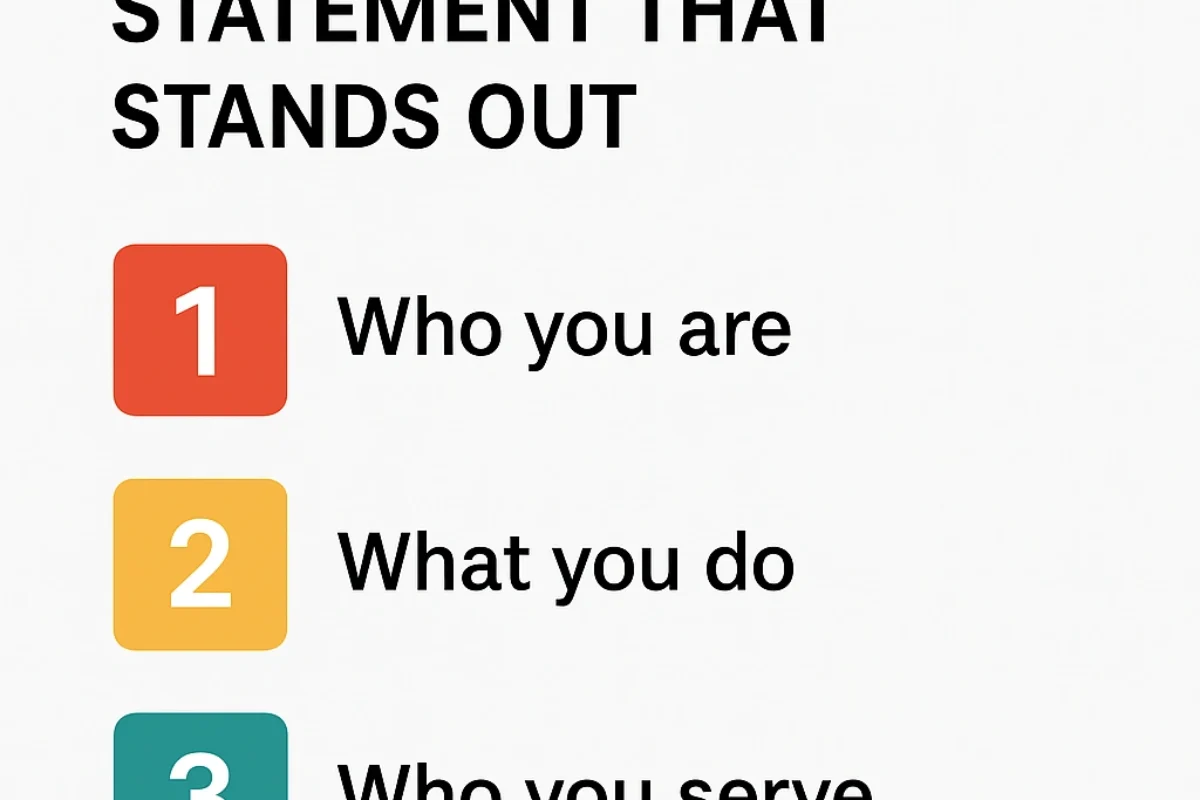
Part 1: Who You Help (Your Audience)
Be specific. “Businesses” is too broad. “Early-stage SaaS startups” is focused. Ask yourself: What industry are they in? What are their typical job titles? What are their biggest professional challenges or aspirations?
Part 2: How You Help Them (Your Value Proposition)
What problem do you solve? Use a strong action verb. “I help… grow their online presence” or “I build… scalable software solutions.” Ask yourself: What are the primary actions you take? What unique skills do you apply? Are you a creator, a strategist, a problem-solver?
Part 3: How You Do It (Your Unique Method/Skills)
What’s your secret sauce? This is your key differentiator. “through data-driven SEO strategies” or “by leveraging human-centered design principles.” Ask yourself: What makes your process special? Is it your unique blend of technical and creative skills?
Part 4: What’s the Result? (Your Impact)
What is the ultimate, tangible outcome for your audience? “…so they can increase revenue and market share.” Ask yourself: How do you make their jobs easier, their companies more profitable, or their lives better? What transformation do you enable?
Putting It All Together: Real-World Examples
Let’s see the formula in action across different professions and career stages.
For a Software Developer:
“I build scalable, user-friendly mobile applications for high-growth tech companies, leveraging Swift and Kotlin to create seamless user experiences that drive engagement and retention.”
For a Marketing Manager:
“I help B2B technology brands translate complex features into compelling stories, using a content-first marketing approach to build brand authority and generate qualified leads.”
For a Recent Graduate:
“I am a recent finance graduate passionate about helping mission-driven organizations achieve their goals through meticulous financial analysis and data-driven forecasting, aiming to provide the insights needed for sustainable growth.”
For a Career Changer:
“I leverage a decade of experience in customer service to help user-focused tech companies improve their product experience, applying my expertise in empathy and problem-solving to bridge the gap between user needs and technical solutions.”
Comparison: Statement vs. Headline vs. Bio
It’s easy to confuse these terms. Your statement is the core DNA; the headline and bio are how that DNA is expressed in different environments. Here’s a clear breakdown of how they differ and work together.
| Element | Purpose | Where to Use It |
|---|---|---|
| Personal Branding Statement | Your core message; the internal compass for your brand. It’s the full, ideal sentence that defines your value. | As the foundation for all other brand assets. You might say this full version in an interview or networking conversation. |
| Professional Headline | A short, keyword-rich version of your statement, optimized for search and quick glances. | LinkedIn headline, Twitter/X bio. (e.g., “Content Marketer for B2B SaaS | SEO & Lead Gen”) |
| Professional Bio | A longer, narrative version of your statement (1-3 paragraphs) that tells your story, includes accomplishments, and shows personality. | LinkedIn “About” section, personal website, speaker introductions, and cover letters. |
Common Statement Mistakes to Avoid
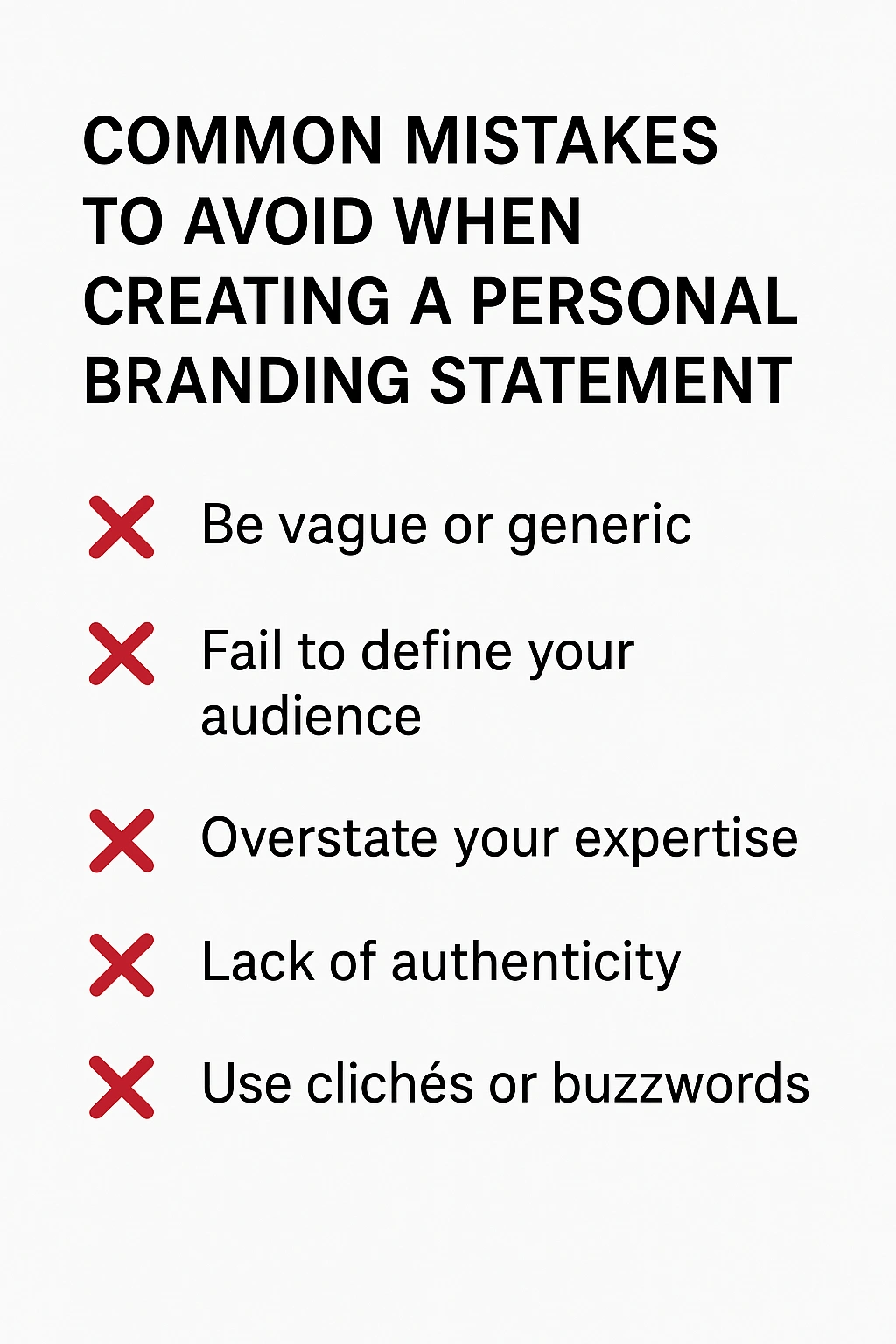
- Using Vague Buzzwords: Phrases like “results-oriented professional,” “passionate team player,” or “strategic thinker” are meaningless filler. They say nothing specific about you. Instead of “results-oriented,” say “grew revenue by 30%.” Be specific.
- Making It All About You: A statement like “I am seeking a challenging role where I can grow my skills” is focused on your needs. A great statement focuses on the value you provide to others: “I help teams achieve their goals by…”
- Trying to Be Everything to Everyone: A statement that tries to appeal to every possible audience (“I help businesses with marketing”) will resonate with no one. A strong brand requires a specific niche (“I help dentists acquire new patients through local SEO”).
- Forgetting to Be Authentic: Your statement should sound like you. If you’re a creative, energetic person, don’t write a dry, corporate statement. Let your personality shine through in your word choice. If it feels unnatural or inauthentic to say, it’s not the right statement for your brand.
- Being Too Humble: Many people are afraid of sounding arrogant, so they downplay their accomplishments. Your branding statement is not the place for false modesty. Own your expertise and state your value with confidence.
- Making It Too Long or Complicated: The goal is a concise, memorable pitch. If it takes more than one or two sentences or is filled with jargon your audience won’t understand, it will fail to make an impact. Simplicity is key.
Expert Tips & Best Practices
- Start with a Brain Dump: Don’t try to write the perfect sentence on your first try. Start by writing down all your skills, passions, accomplishments, and the types of problems you love to solve. Look for patterns and themes that emerge.
- Read It Out Loud: This is a crucial step. Does it flow naturally? Is it easy to say and understand? If you stumble over the words or it sounds like a robot, it’s too complicated. Simplify it.
- Test It on a 5-Year-Old (Figuratively): Can you explain what you do in a way that is simple and easy to grasp for someone outside your industry? Avoiding jargon and focusing on simple, powerful language is the ultimate sign of sophistication.
- Get Feedback: Once you have a draft, run it by trusted colleagues, mentors, or even past clients. Ask them, “Does this sound like me? Is this an accurate reflection of the value I provide?” Their feedback is invaluable for spotting blind spots.
- Treat It as a Living Document: Your brand will evolve as your career progresses. Don’t treat your statement as something you write once and never touch again. Revisit and refine it annually or after any significant career milestone.
“Your personal brand statement is the promise you make to your professional world. Make sure it’s a promise you can, and want to, keep every single day,” says a career expert from Harvard Business Review.
Frequently Asked Questions (FAQ)
Q: How long should a personal branding statement be?
A: Your core personal branding statement should be concise and memorable, typically one to two sentences long. Think of it as your professional tagline or a 30-second elevator pitch. You can then expand on it in different contexts, like your LinkedIn ‘About’ section or a cover letter.
Q: Where is the best place to use my personal branding statement?
A: Your statement is versatile. Use it in your LinkedIn headline and About section, your social media bios, your professional website’s homepage, your resume summary, and as the opening for your cover letters. It’s also the perfect answer to the classic interview question, ‘Tell me about yourself.’
Q: Should I write my statement in the first or third person?
A: For most applications, like social media bios and networking, the first person (‘I help…’) is more authentic and engaging. For more formal contexts like an official speaker bio, the third person (‘She is a marketing expert who helps…’) may be more appropriate. Start by writing it in the first person.
Q: How is a personal branding statement different from a mission statement?
A: A mission statement is typically broader and more focused on your long-term purpose or ‘why.’ A personal branding statement is more practical and outward-facing; it’s about the value you deliver to a specific audience *right now*. Your mission fuels your brand, but your branding statement is the message you use to communicate it.
Q: How often should I update my personal branding statement Forbes?
A: Review your statement every 6 to 12 months, or whenever you experience a significant career change, such as a promotion, a new job, or a shift in your professional goals. Your brand should evolve with you, so your statement should always be an accurate reflection of your current value and aspirations.
Conclusion
Crafting a strong personal branding statement is essential for clearly communicating your value and expertise. A well-defined personal branding statement helps you stand out, attract the right opportunities, and guide your professional decisions. By refining your personal branding statement, you create a consistent narrative across networking, online presence, and career interactions. Your personal branding statement not only reflects who you are and what you offer but also serves as a strategic tool to build trust, credibility, and recognition in your industry.