Introduction
What is Remote Learning Productivity?
Remote learning productivity is not about studying for 12 hours a day or turning yourself into a robot. It’s the art and science of creating a sustainable system that allows you to achieve your learning goals effectively and efficiently, without sacrificing your well-being. It’s a holistic approach that encompasses three key areas:
- Environment Design: Intentionally crafting a physical and digital space that minimizes distractions and signals to your brain that it’s time to focus.
- Time & Task Management: Implementing a structured approach to your schedule and assignments, so you’re in control of your day, not the other way around.
- Energy & Focus Management: Understanding that your ability to concentrate is a finite resource and using techniques to maximize deep work and prevent burnout.
In 2025, with remote and hybrid models becoming a permanent fixture in education and work, mastering these skills is no longer just about getting good grades; it’s about developing the core competencies needed for a successful modern career.
Why Mastering Productivity is Your Remote Learning Superpower
Overcome Procrastination and Stay Motivated
Procrastination thrives in the absence of structure. By creating clear routines, breaking down large tasks, and setting specific goals for each study session, you remove the ambiguity that fuels procrastination. This builds momentum and a sense of accomplishment, which are the key drivers of long-term motivation.
Achieve Better Academic Results in Less Time
Productivity isn’t about working more; it’s about working smarter. Techniques like deep work and time blocking allow you to achieve a state of high concentration, where you can learn complex topics and complete assignments much faster and more effectively than if you were multitasking with constant interruptions.
Develop Lifelong Skills for a Remote-First World
The self-discipline, time management, and focus skills you build as a remote learner are the exact same skills that are highly valued in the modern, remote-first workplace. By mastering them now, you’re not just investing in your education; you’re building a foundation for your future career. For more on future-proofing your career, check out our guide on online learning platforms.
The 4 Pillars of Remote Learning Productivity
Build your productivity system on these four foundational pillars.
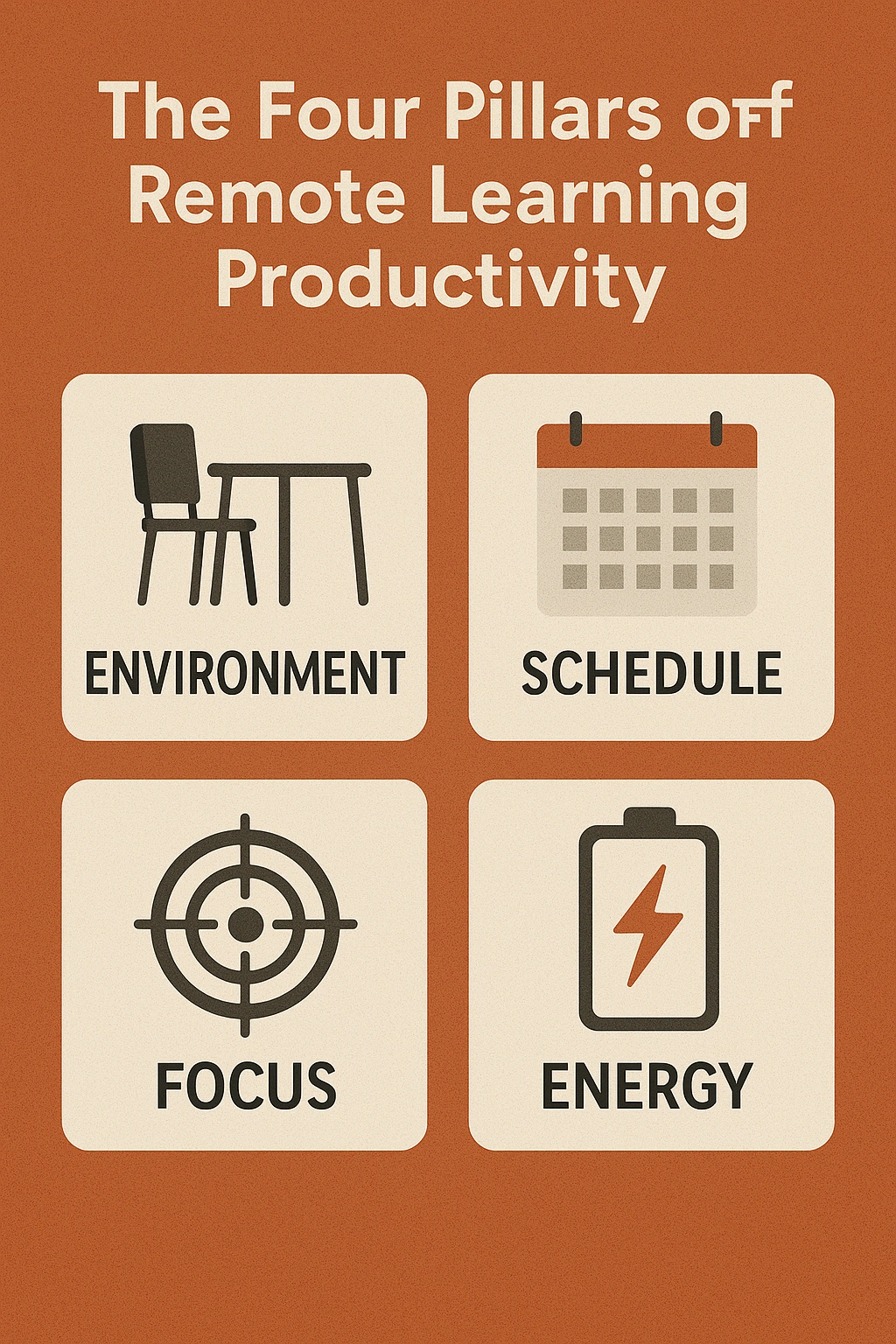
Pillar 1: Engineer Your Environment
Your environment is the most powerful, yet overlooked, factor in your productivity.
- Create a Dedicated Study Space: This is non-negotiable. It can be a desk, a corner of the dining table, or any space that is used *only* for studying. This creates a powerful psychological cue that when you’re in this space, it’s time to work. Never study on your bed.
- Optimize for Focus: Keep your space clean and clutter-free. Have everything you need within arm’s reach (notebooks, pens, water). Face a wall to minimize visual distractions.
- Curate Your Digital Environment: Turn off all non-essential notifications on your phone and computer. Use a browser extension like Freedom or BlockSite to block distracting websites during your study blocks.
Pillar 2: Architect Your Schedule
Don’t leave your day to chance. A structured schedule is your roadmap to success.
- Time Block Your Week: At the start of each week, open your calendar and schedule everything: classes, dedicated study blocks for each subject, meals, exercise, and breaks. This turns your to-do list into a concrete plan.
- Create a “Startup” and “Shutdown” Routine: Start your day with a 15-minute routine to review your schedule and set your goals. End your day with a shutdown routine where you review what you accomplished and plan the next day. This creates clear boundaries between “study time” and “personal time.”
Pillar 3: Master Deep Work
Deep work is the ability to focus without distraction on a cognitively demanding task. It’s the superpower of the 21st century.
- Use the Pomodoro Technique: Work in focused 25-minute sprints, followed by a 5-minute break. This technique is incredibly effective for breaking through the initial resistance of starting a task.
- Identify Your “Productivity Peak”: Are you a morning lark or a night owl? Schedule your most challenging, cognitively demanding tasks during your peak energy hours. Use your lower-energy hours for easier tasks like responding to emails or watching lectures.
Pillar 4: Manage Your Energy
You can’t be productive if you’re exhausted.
- Schedule Your Breaks: Breaks are not a sign of weakness; they are essential for focus and retention. Schedule short breaks every hour and a longer lunch break. Get up, stretch, and step away from your screen.
- Prioritize Sleep and Exercise: These are the most powerful productivity tools you have. A lack of sleep severely impairs cognitive function. Regular exercise is proven to boost focus and reduce stress.
Comparison: Productivity Methods for Different Learners
There’s no one-size-fits-all solution. Choose a method that aligns with your personality and learning style.
| Method | Core Principle | Best For |
|---|---|---|
| The Pomodoro Technique | Short, focused sprints with frequent breaks. | Students who struggle with procrastination or get easily distracted. |
| Time Blocking | Assigning every minute of your day to a specific task. | Students who thrive on structure and want to maximize every hour of their day. |
| Eat the Frog | Tackling your most important and challenging task first thing in the morning. | Students who have one major project or subject that they tend to avoid. |
Common Productivity Mistakes to Avoid
- Multitasking: The myth of multitasking is the #1 productivity killer. Your brain can only focus on one thing at a time. Switching between tasks creates “attention residue,” which shatters your focus.
- Not Setting Boundaries: Allowing family, roommates, or notifications to interrupt your scheduled study blocks. Communicate your schedule and use physical cues to signal that you’re in a focus session.
- Creating an Unrealistic Schedule: Packing your calendar with 10 hours of back-to-back study with no breaks is a recipe for burnout. Be realistic and schedule downtime.
Expert Tips & Best Practices
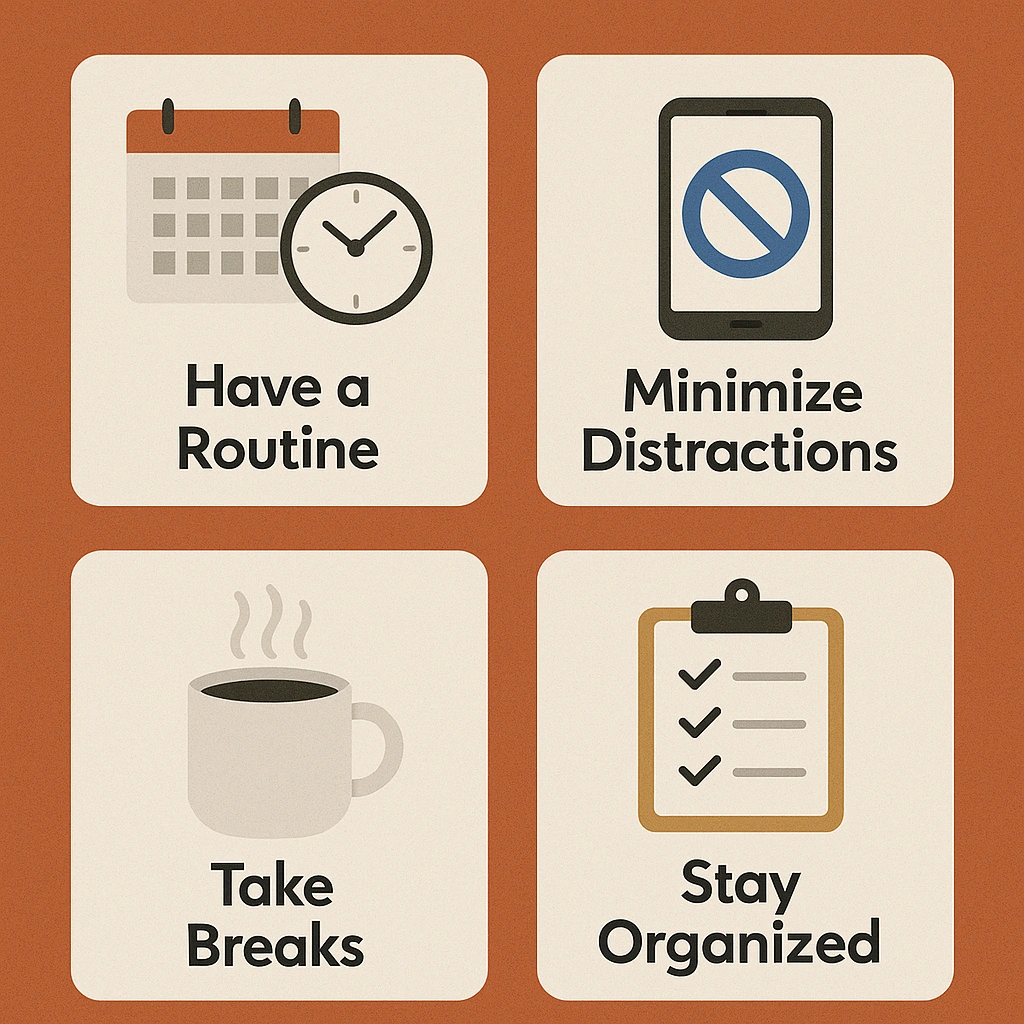
- Use the 2-Minute Rule: If a task takes less than two minutes to complete (e.g., replying to a quick email, uploading a file), do it immediately instead of letting it clutter your to-do list.
- “Dress for the Job”: You don’t need a suit, but changing out of your pajamas into comfortable day clothes can create a powerful psychological shift to get you in the mindset for work.
- Create a “Distraction To-Do List”: When a distracting thought pops into your head during a focus session, quickly jot it down on a separate piece of paper to deal with later. This acknowledges the thought without derailing your focus.
“Productivity is not about having more discipline. It’s about building better systems. A well-designed system makes productivity the path of least resistance,” says a productivity expert from a leading tech publication.
Frequently Asked Questions (FAQ)
Q: How can I stay motivated when learning from home?
A: Motivation in remote learning comes from clarity and routine. Start by setting clear, small, achievable goals for each study session. Create a dedicated study space and a consistent daily routine to signal to your brain that it’s time to work. Finally, reward yourself for completing tasks to build positive momentum.
Q: What is the best way to structure my study day at home?
A: The most effective structure is often time blocking. At the beginning of the day or the week, schedule specific blocks of time for lectures, reading, assignments, and breaks. This prevents you from making constant decisions about what to do next and ensures you allocate enough time for all your subjects. Be sure to include breaks to avoid burnout.
Q: Is it bad to study on my bed?
A: Yes, it’s generally a bad idea. Your brain associates your bed with sleep and relaxation. Studying there can lead to drowsiness and reduced focus, and it can also make it harder to fall asleep at night. A dedicated desk or table, even a small one, is a much better choice for productivity.
Q: How do I deal with distractions from family or roommates?
A: Clear communication is key. Share your study schedule with them and explain when you need uninterrupted focus time. Use a physical signal, like a sign on your door or wearing headphones, to indicate you’re in a deep work session. Setting boundaries respectfully is crucial for successful home study.
Q: What is the Pomodoro Technique?
A: The Pomodoro Technique is a time management method where you break down work into focused 25-minute intervals, separated by short 5-minute breaks. After four ‘Pomodoros,’ you take a longer break (15-30 minutes). It’s highly effective for overcoming procrastination and maintaining high levels of focus during study sessions Google Scholar.
Conclusion